The church and the street
St Paul's Within the Walls in Rome
St Paul's Within the Walls on Via Nazionale: who built Rome's Victorian church, what the Burne-Jones mosaics show and how to reach it for a concert.
Reserve seats for the tenors ↗Quick answer
St Paul's Within the Walls is the Episcopal church on Via Nazionale in Rome, often called the American Church. The English architect George Edmund Street designed it in red brick and white travertine, and its apse and chancel carry mosaics by Edward Burne-Jones. It was the first non-Catholic church built in Rome after 1870. Concerts of opera arias take place inside it, and the street it stands on links Termini station with Piazza Venezia.
St Paul's at a glance
| Detail | |
|---|---|
| Address | Via Nazionale 16a, Rome |
| Architect | George Edmund Street |
| Mosaics | Edward Burne-Jones |
| Stands on | Via Nazionale |
What kind of church it is
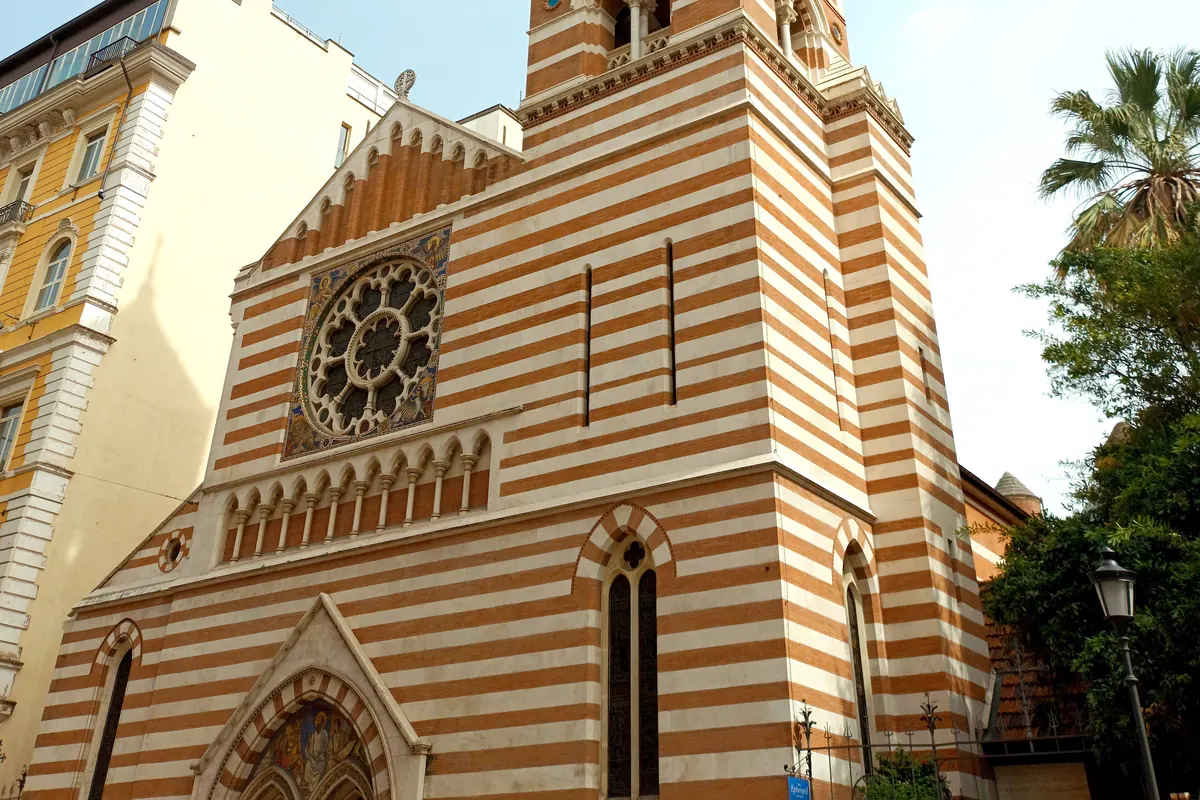
St Paul's Within the Walls, in Italian San Paolo dentro le Mura, belongs to the Convocation of Episcopal Churches in Europe and is also known as the American Church in Rome. It stands on Via Nazionale, and Turismo Roma describes it as the first non-Catholic place of worship built in Rome after the unification of Italy. The name distinguishes it from the great basilica of St Paul outside the Walls, which lies beyond the old city wall. This one stands inside the city, on a street that did not exist before the 1870s. For a visitor the distinction matters, because the two churches are in different parts of Rome, and the one on Via Nazionale is the one where the concerts take place.
Why a Protestant church could be built here
Building a Protestant church in Rome became possible after the Kingdom of Italy captured the city from the Papacy in 1870. The Episcopal congregation, made up largely of expatriates, commissioned the English architect George Edmund Street in 1872. The foundation stone was laid on 25 January 1873, the Feast of the Conversion of St Paul, and the church was inaugurated in 1876 and completed in 1880. The congregation's rector, Robert J. Nevin, was a keen art collector and drove the decoration that followed. Street approached Burne-Jones in 1881 and died the same year, and Nevin travelled to England to confirm and expand the commission himself.
The architect and the striped walls
Street designed the church in a mixed Romanesque-Gothic style, using red brick and white travertine in alternating bands. The effect is visible from the pavement: horizontal stripes climb the façade and the bell tower, which has mullioned windows. Turismo Roma links the design to the English Arts and Crafts movement. Inside, the church has three naves, and the striped pattern continues on the walls, so that the whole building reads as a single coloured object rather than a plain shell with decoration added. The pattern also explains why the church looks unlike its neighbours, which are plastered and painted in the ochres and pinks of Rome.
The Burne-Jones mosaics
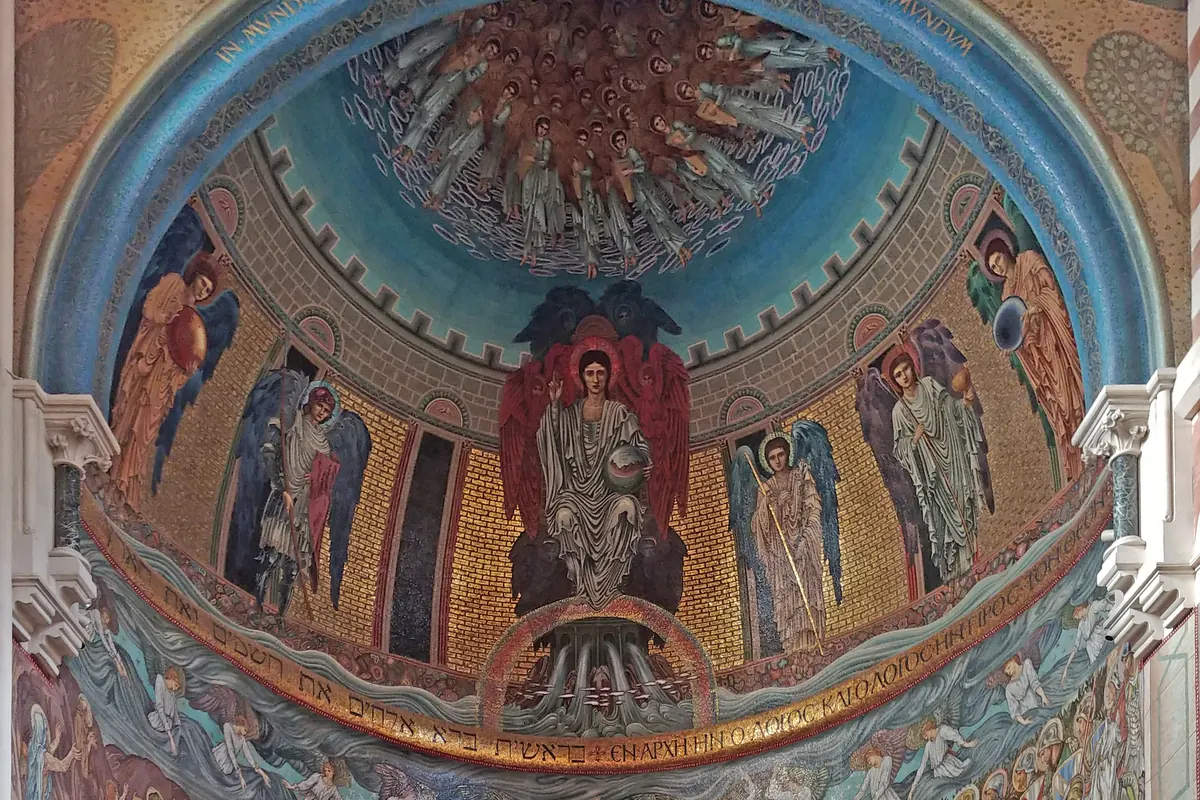
The mosaics are the church's chief treasure. Wikipedia counts four by Edward Burne-Jones, the Pre-Raphaelite painter, and calls them the largest works of his career. He admired the mosaics of Ravenna, which he had visited in 1873, and designed cartoons that he sent to Venice with instructions about colour. The Venice and Murano Glass and Mosaic Company set the glass pieces on those cartoons, and the colours were chosen in collaboration with William Morris. Burne-Jones never travelled to Rome to supervise, sending his assistant Thomas Rooke instead. The result is a set of mosaics designed in England, made in Venice and installed in Rome, which is an unusual route for a work of art to take.
The four mosaics in order
Christ Enthroned in the Heavenly Jerusalem fills the semi-dome of the apse and was completed in 1885. The two chancel panels leading toward it, The Annunciation and The Tree of Life, date from 1894. In the Annunciation the scene is set in a desert, and in The Tree of Life Christ is shown in the pose of crucifixion superimposed on a green tree. The fourth mosaic, lower on the apse wall and known as The Earthly Paradise or The Church Militant, was completed in 1907 by Rooke after Burne-Jones had died. The Italian state has declared the mosaics a national monument, which is why the church counts as a cultural stop and not only a place of worship.
Glass, tiles and the façade mosaics
The mosaics by Burne-Jones are not the only decoration. The nave windows, made by the English firm Clayton & Bell, tell the life of St Paul in stained glass, and the firm was also influenced by the Pre-Raphaelite movement. Majolica tiles inside the church are attributed to William Morris. On the outside, the mosaics around the rose window and the portal date from the early twentieth century and are the work of the American artist George Breck, who studied in Rome between 1897 and 1902. They show the four evangelists and St Paul among Roman soldiers, and they are worth a look from the pavement before you go in.
Saints with familiar faces
Look closely at the figures and some of them seem oddly modern. Turismo Roma notes that certain saints carry the features of historical figures: St Andrew resembles Abraham Lincoln, St James resembles Giuseppe Garibaldi and St Patrick resembles Ulysses S. Grant. Wikipedia adds that the fourth mosaic includes figures with faces modelled on contemporary people. The choice fits a church built by an American congregation in the years when Rome was becoming the capital of a united Italy, and it gives visitors a small game to play while the music begins. Bring the idea with you, and look at the faces in the lower mosaic when your eyes tire of the stripes.
Via Nazionale, the street outside
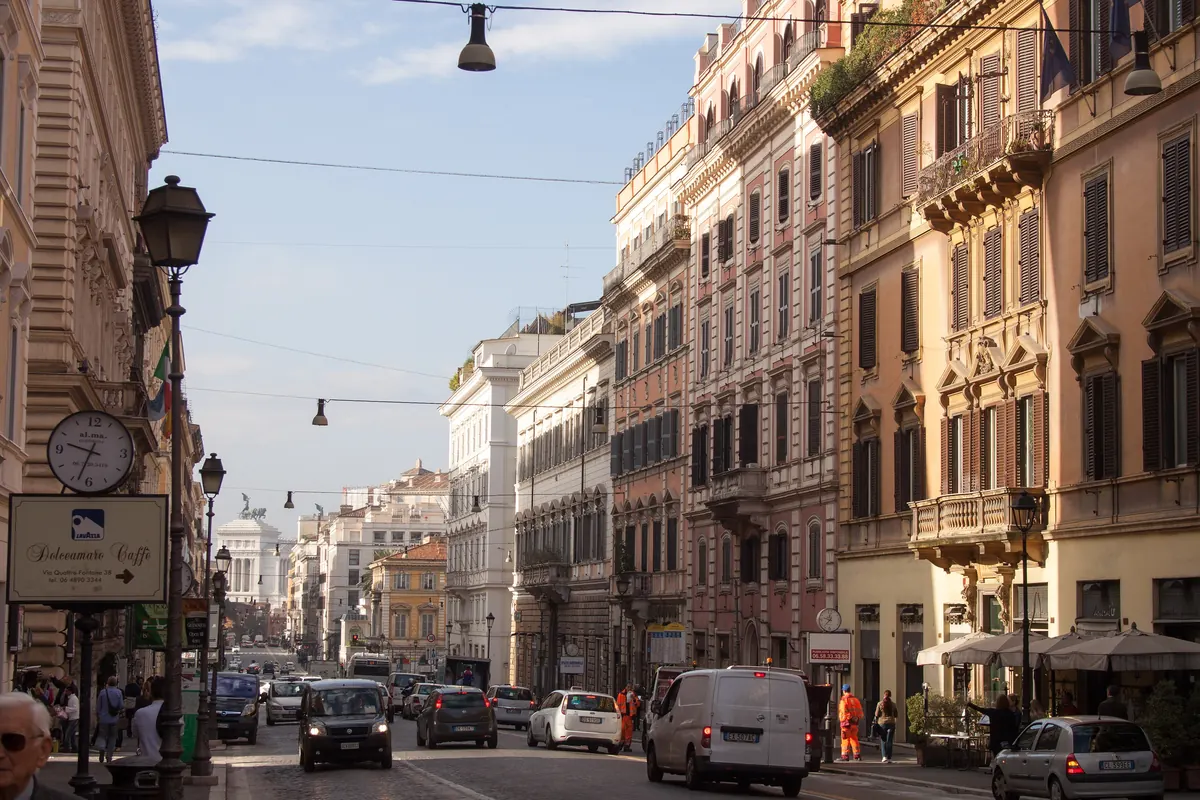
The street began as via Pia, named for Pius IX, who wanted a road between Termini station and the city centre. It was completed at the end of the nineteenth century, pushed by Risorgimento figures who wanted a new Rome fit for the capital of the unified kingdom. It runs from Piazza della Repubblica toward Piazza Venezia, and its buildings include the Palazzo delle Esposizioni of 1883 and Palazzo Koch, the seat of the Banca d'Italia, of 1892. Building it meant demolishing older palazzi, and St Paul's, completed in 1880, is listed among the street's notable buildings. Rome's centre is compact enough that many visitors arrive on foot from their hotel, so leave time for traffic and crowds, especially in the early evening.
Getting there and arriving
The church is at Via Nazionale 16a. Because the street was planned to link Termini station with the centre, the station is a natural starting point if you arrive by train, and the street continues toward Piazza Venezia if you are coming from the centre. Check routes and timetables with the city's transport operator close to your date. For a concert, your confirmation gives the start time. Arrive with a margin, because the building rewards a few minutes of looking before the music starts, and a hurried arrival wastes the best part of the visit. If you travel with a group, agree a meeting point on the street outside, so that nobody waits in the wrong place.
Who this isn't for
This guide is not for anyone planning a visit as a worshipper or a sightseer who wants a daytime tour, because the concert ticket covers the evening performance and nothing else, and it does not turn into a tour of the building. For service times and daytime visiting, contact the church directly through the website that Turismo Roma lists. And if your interest is Rome's ancient or Renaissance past, the church will feel late, since it belongs to the 1870s and its mosaics to the years from 1885 to 1907. Arriving settled, rather than rushed, also helps the quiet opening of a concert, when the room is still adjusting to the first notes.
Going to a concert in a church
A concert in a working church asks for the manners of a quiet room. Switch your phone to silent, take your seat in good time and keep conversation low before the music begins. The concerts are marked wheelchair accessible, and pets are not allowed, so plan accordingly. Pack a light layer, because a brick-and-stone building can feel close on a warm evening and cool in other weather. Above all, give the first piece your attention, because it is the moment when the room and the voices meet, and the rest of the evening follows from it.
Frequently asked questions
Who designed St Paul's Within the Walls?
The English architect George Edmund Street, who was commissioned by the Episcopal congregation in 1872.
Who made the mosaics?
Edward Burne-Jones designed four of them, and the Venice and Murano Glass and Mosaic Company made them. Thomas Rooke finished the fourth in 1907.
Is it the same as St Paul outside the Walls?
No. That is a separate basilica beyond the old wall. This church is the Episcopal church on Via Nazionale.
Where exactly is it?
Via Nazionale 16a, Rome. The street runs from Piazza della Repubblica toward Piazza Venezia.
Can I hear a concert there?
Yes. Opera concerts take place in the church, and the home page of this site lists the ones you can book.
Is it a Catholic church?
No. It belongs to the Convocation of Episcopal Churches in Europe and is also called the American Church in Rome.
Sources